
Pigeon
1801 to 1825
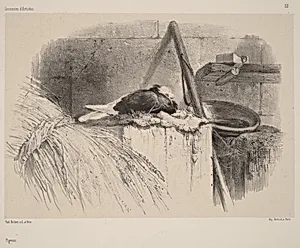
Medium
lithograph
Classification
Department
CG-E
Museum
National Gallery of Art, Washington, D.C.
Credit
Ailsa Mellon Bruce Fund
Accession Number
1975.34.47
Rights
Public Domain
Art Historical Context
**Pigeon** by Karl Bodmer, aograph from around 1801–1825, captures the artist's meticulous eye for natural detail during his travels in early 19th-century North America.mer, a Swiss painter renowned for his expedition with Prince Maximilian of Wied-Neuwied along the Missouri River in the 1830s, documented the continent's wildlife and landscapes with scientific precision. This print likely depicts a passenger pigeon or similar species, emblematic of the abundant fauna explorers encountered before widespread habitat loss. As a lithograph—a revolutionary printmaking technique invented in 1798—**Pigeon** exemplifies Bodmer's skill in translating vibrant watercolors into reproducible works. Published in the influential atlas *Voyages dans l'intérieur de l'Amérique du Nord* (1839–1841), it allowed wide dissemination of his observations. The medium's greasy crayon on stone enabled subtle tonal gradations, blending Romantic naturalism with ethnographic accuracy. Housed in the National Gallery of Art's CG-E department through the Ailsa Mellon Bruce Fund, this print holds cultural value as a window into pre-industrial America. It reminds visitors of biodiversity's fragility, as species like the passenger pigeon vanished by 1914, underscoring Bodmer's enduring legacy in preserving vanishing worlds.
About the Artist
Karl Bodmer · 1809–1893
Johann Carl Bodmer was born on February 11, 1809, in Zürich, Switzerland, and received his training as a painter and engraver under his uncle Johann Jakob Meier, who had himself studied under the prominent engraver Heinrich Füssli. By the late 1820s Bodmer had relocated to Koblenz, Germany, where his work came to the attention of Prince Maximilian zu Wied-Neuwied, a German naturalist-explorer plan...