
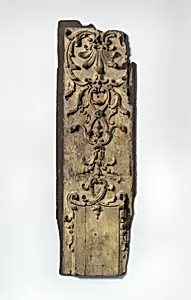
Pilaster fragment
Unknown Artist
early 18th century
Medium
Wood, painted
Dimensions
5-1/8 x 16-1/8 in. (13.0 x 41.0 cm)
Classification
Woodwork
Culture
French
Department
European Sculpture and Decorative Arts
Museum
Metropolitan Museum of Art, New York, NY
Credit
Gift of J. Pierpont Morgan, 1906
Accession Number
07.225.242
Rights
Public Domain
Art Historical Context
This delicate pilaster fragment, crafted in early 18th-century France, offers a glimpse into the opulent world of French decorative arts during the Regency period. Pilasters like this one—flattened, columnar elements projecting from walls—were essential architectural ornaments in grand interiors, such as hôtels particuliers or châteaux. Adorning walls, doorways, or furniture, they added rhythm and grandeur to spaces influenced by the fading Baroque style and emerging Rococo elegance. Though created by an unknown artisan, its survival as a modest 5-1/8 x 16-1/8-inch piece speaks to the exquisite craftsmanship of French woodworkers, who elevated everyday architecture into art. Carved from wood and vividly painted, the fragment exemplifies the era's mastery of mixed media. Wood was prized for its workability, allowing intricate molding and gilding, while paint added lifelike depth and color, mimicking costly stone or marble. Such techniques made lavish decoration accessible to the nobility, reflecting France's cultural prestige under Louis XV. Today, it resides in The Metropolitan Museum of Art's Department of European Sculpture and Decorative Arts, a generous 1906 gift from J. Pierpont Morgan, inviting us to appreciate the fragility and finesse of these once-overlooked architectural jewels.