
Pilgrim Flask
probably 1556–67
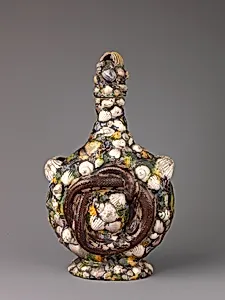
Medium
Earthenware with colorless and transparent or opaque pigmented green, purple, blue, yellow, red-brown, and black lead glazes.
Dimensions
H. 31 cm, w. 19cm.
Classification
Ceramics-Faience
Department
Robert Lehman Collection
Museum
Metropolitan Museum of Art, New York, NY
Credit
Robert Lehman Collection, 1975
Accession Number
1975.1.1620
Rights
Public Domain
Tags
Art Historical Context
Behold the *Pilgrim Flask*, a earthenware creation by Bernard Palissy, a pioneering French ceramicist, dating to around 1556–67. Standing 31 cm tall and 19 cm wide, this from the Robert Lehman Collection at the Metropolitan Museum of Art Palissy's rustic style during the French Renaissance. Crafted from faience-like earthenware, it features lead glazes in colorless, transparent, or opaque shades of green, purple,, yellow, red-brown, and black, over intricate molded reliefs. Palissy's innovative technique involved capturing nature's wonders in ceramic form—here, lively depictions of snakes and shells that seem to writhe and curl across the flask's bulbous, pilgrim-inspired shape. These motifs reflect his fascination with the natural world, drawn from his studies of specimens, and his quest to rival metalwork and porcelain with affordable, colorful earthenware. Amid religious turmoil as a Protestant artisan, Palissy's wares symbolized ingenuity and delight in God's creation. This flask not only served practical purposes, like carrying liquids for travelers, but also showcased artistic ambition. Its survival highlights Palissy's enduring legacy as the "king of ceramists," blending science, art, and whimsy in 16th-century Europe. A true treasure for any visitor! (198 words)
About the Artist
Bernard Palissy · 1510–1590
Bernard Palissy (c. 1510–1590), born to a poor family in the Saintonge region of France—possibly in Saintes, Périgord, or near Agen—began his career apprenticed to a glass painter before becoming a wandering journeyman portrait painter, glassworker, and land surveyor across France, the Low Countries, and Italy. He learned the rudiments of pottery in La Chapelle-des-Pots and settled in Saintes as a...