
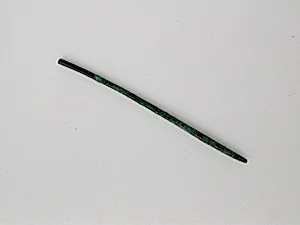
Pin Shank
Geometric Period (800–600 BCE)
Medium
Bronze
Dimensions
7.6 × 0.3 × 0.3 cm (3 × 1/8 × 1/8 in.)
Classification
votive offering
Department
Arts of Greece, Rome, and Byzantium
Museum
Art Institute of Chicago
Accession Number
196464
Rights
Public Domain
About this artwork
This precious bronze object is a votive, or devotional gift, made as an offering to the gods. They come in many forms, such as animals, beads and brooches. Many seem once to have been attached to something else. Votives were hung from sacred trees or placed in sanctuaries around Greece. Once a shrine was full, the votives were ceremonially buried to make room for more offerings.
Art Historical Context
### Pin Shank: A Geometric Greek Votive Treasure Step into the world of ancient Greece with this delicate *Pin Shank*, a bronze from the Geometric Period (. 800–600 BCE). Measuring just 7.6 × 0.3 × 0.3 cm, this slender shaft once formed part of a fibula—a clothing pin used to secure garments like the peplos or himation. Crafted in bronze, a prized metal alloy of copper and tin, it showcases the early Greeks' skill in casting and hammering small-scale metalwork. Housed in the Art Institute of Chicago's Department of Arts of Greece, Rome, and Byzantium, it stands as a classified votive offering, dedicated to deities at sanctuaries. During the Geometric Period, Greek society transitioned from the Bronze Age collapse toward city-states and organized religion. Votive pins like this were common gifts to gods such as Hera or Artemis, left at sacred sites to seek favor, protection, or gratitude. Though simple in form, its precision reflects emerging metallurgical techniques and the period's geometric aesthetic, seen in contemporary pottery with meanders and zigzags—principles that likely influenced decorative metal objects. This unassuming shank whispers of daily life elevated to the divine, bridging personal devotion and artistic innovation in proto-Classical Greece. A testament to how even the smallest items carried profound cultural weight!
About the Artist
Ancient Greek
The artist known simply as "Ancient Greek" represents the anonymous masters of Attic vase painting, a cornerstone of Classical Greek art from the Archaic and Classical periods (circa 700–300 BCE). Little is known of their personal life, as ancient Greek potters and painters rarely signed their works or left biographical traces; early life and training remain not well documented. These creators ope...