
Pine and Brook
16th century
Classification
Painting
Department
Smithsonian Collection
Museum
Smithsonian American Art Museum
Credit
Gift of Charles Lang Freer
Accession Number
F1916.68
Rights
Public Domain
Tags
About this artwork
To 1916
Art Historical Context
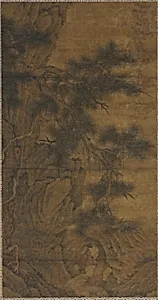
**Pine and Brook** is a captivating 16th-century Chinese painting from the Ming dynasty1368–1644), evoking the serene beauty of nature through its depiction of towering mountains, a resilient pine tree, and aandering river or brook. Created during a golden age of Chinese art, literati painters emphasized harmony between humans and the cosmos, this anonymous work exemplifies the era's fascination with vast, mist-shrouded vistas. Such landscapes weren't mere scenery; they symbolized enduring virtues—pines for longevity and resilience, mountains for stability, and flowing waters for life's continuity—inviting contemplation and spiritual reflection. Part of the renowned Charles Lang Freer collection, this painting was gifted to the Smithsonian American Art Museum, where it entered the collection by 1916. Freer, a pioneering American industrialist and collector, amassed exceptional examples of Asian art, bridging Eastern traditions with Western audiences. Though the medium remains unidentified, its classification as a painting aligns with Ming techniques like ink on silk or paper, often employing subtle washes and precise brushwork to capture atmospheric depth. Visitors to the Smithsonian can appreciate how *Pine and Brook* transports us to an timeless realm of quiet majesty, a testament to China's enduring artistic legacy.
About the Artist
Unknown
The artist designated as "Unknown" in our virtual museum's collection exemplifies a poignant chapter in art history: creators whose identities have faded into obscurity despite the enduring power of their work. With only one known artwork attributed to them in our holdings, this figure represents countless anonymous hands that shaped visual culture across centuries. Museums worldwide, including th...