
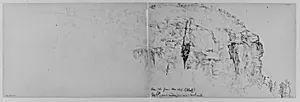
Pine Cliff, Mohonk, 1871 (from Sketchbook)
ca. 1870–71
Medium
Graphite on paper
Dimensions
5 1/2 x 8 3/4 in. (14 x 22.2 cm)
Classification
Drawing
Culture
American
Department
The American Wing
Museum
Metropolitan Museum of Art, New York, NY
Credit
Gift of S.B. Luyster, 1936
Accession Number
36.124w verso
Rights
Public Domain
Tags
Art Historical Context
Daniel Huntington's *Pine Cliff, Mohonk 1871 (frombook)* captures the rugged beauty of New York's Hudson Valley in a delicate graphite sketch. Created around 1870–71, this intimate landscape drawing (5 1/2 x 8 3/4 in.) depicts the dramatic Pine Cliff at Lake Mohonk, a retreat that drew artists seeking nature's sublime power. Huntington, a leading figure in 19th-century American art and president of the National Academy Design, was known for his ties to the Hudson River School, which celebrated the American wilderness as a source of national pride. As a sketchbook study, the work highlights Huntington's preparatory process, using graphite's fine lines to render textures of rock faces, pines, and distant vistas with precision and spontaneity. This medium was ideal for on-site observation, allowing artists to capture fleeting light and form before translating them into larger oils. Housed in The Metropolitan Museum of Art's American Wing since its 1936 gift by S.B. Luyster, it exemplifies the era's romantic embrace of untamed landscapes amid rapid industrialization. This modest gem invites visitors to appreciate the artist's keen eye for detail, bridging intimate fieldwork with the grand tradition of American landscape art.
About the Artist
Daniel Huntington · 1816–1906
Daniel Huntington (1816–1906) was born into a prominent New York family on October 4, 1816, descending from distinguished New England lineage. His early education began at age fourteen at Smith's Academy in New Haven, followed by Yale College, where he studied with Samuel F. B. Morse, the inventor, artist, and president of the National Academy of Design, in 1835. After a disciplinary incident invo...