
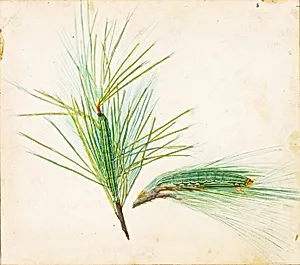
Pine-Tuft Caterpillar, study for book Concealing Coloration in the Animal Kingdom
Medium
Painting
Classification
Painting
Department
Smithsonian Collection
Museum
Smithsonian American Art Museum
Credit
Smithsonian American Art Museum, Gift of the heirs of Abbott Handerson Thayer
Accession Number
1950.2.21
Rights
Public Domain
Tags
Art Historical Context
Welcome to the Smithsonian American Art Museum, where Gerald H. Thayer's *Pine-Tuft Caterpillar* invites us into the fascinating world of natural camouflage. This meticulous painting, a study for the influential book *Concealing Coloration in the Animal Kingdom*, captures the subtle artistry of a caterpillar blending seamlessly with pine needles. Created by Thayer, whose family ties to artist Abbott Handerson Thayer are honored through the gift from his heirs, the work exemplifies early 20th-century scientific illustration. Thayer's piece emerged from a groundbreaking theory positing that animal patterns serve protective purposes rather than mere decoration—a concept that influenced military camouflage during World War I. As a preparatory study, the painting highlights the precision required in watercolor or oil techniques (common for such natural history works) to reveal how the caterpillar's tufted form mimics its pine surroundings, challenging viewers to spot the creature at first glance. This artwork bridges art and science, showcasing Thayer's skill in hyper-realistic rendering to educate and enchant. Donated to the Smithsonian, it reminds us how observation of nature's deceptions can inspire both artistic innovation and deeper ecological understanding. Spot the caterpillar—it's a delightful test of perception!