
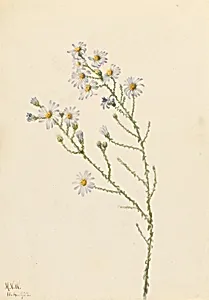
Pineland Aster (Aster squarrosus)
Medium
Painting
Classification
Painting
Department
Smithsonian Collection
Museum
Smithsonian American Art Museum
Credit
Smithsonian American Art Museum, Gift of the artist
Accession Number
1970.355.498
Rights
Public Domain
Tags
Art Historical Context
Mary Vaux Walcott'sPineland Aster (Asterarrosus)*, in 1922, the delicate beauty of this native North American wildflower with scientific precision and artistic grace. Walcott, a pioneering botanist and artist (1860–1940), dedicated much of her career to documenting the continent's flora through watercolor paintings, culminating in her five-volume *North American Wild Flowers* between 1924 and 1928. This piece, now in the Smithsonian American Art Museum as a gift from the artist herself, exemplifies her fieldwork in remote areas like the Canadian Rockies and Appalachians, where she sketched specimens en plein air. As a painting in the tradition of botanical illustration, it highlights Walcott's mastery of translucent watercolors—though classified broadly as a painting—to render the aster's square-stemmed structure, starry lavender petals, and fuzzy leaves in lifelike detail. These works bridged art and science during the early 20th century, when such illustrations served as vital references before widespread photography. Walcott's efforts preserved endangered species' likenesses, earning praise from botanists and collectors alike. Visitors to the Smithsonian will appreciate how *Pineland Aster* reflects an era of exploration and conservation, inviting us to marvel at nature's intricacies through a woman's keen eye.