
Pitcher
Unknown Artist
early 15th century
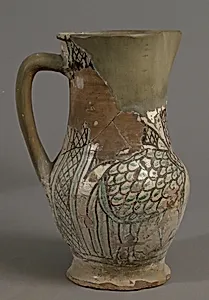
Medium
Earthenware, tin-glaze (Majolica)
Dimensions
Overall: 8 1/8 x 5 9/16 x 4 5/8 in. (20.6 x 14.2 x 11.8 cm)
Classification
Ceramics
Culture
Italian
Department
Medieval Art
Museum
Metropolitan Museum of Art, New York, NY
Credit
Gift of Wilhelm Bode, 1911
Accession Number
11.163.4
Rights
Public Domain
Tags
Art Historical Context
This elegant pitcher, crafted by an unknown Italian artist in the early 15th century, exemplifies the vibrant world of maiolica—tin-glazed earthenware that became a hallmark of Italian ceramics during the late Middle Ages and early Renaissance. Standing at just over 8 inches tall, its compact form (8 1/8 x 5 9/16 x 4 5/8 in.) made it ideal for serving wine, water, or other beverages in affluent households. The tin-glaze technique, adapted from Islamic traditions via Spain, created a smooth, white surface perfect for colorful painted decorations, often featuring lively motifs like animals, as seen here. Housed in the Metropolitan Museum of Art's Medieval Art department (gift of Wilhelm Bode, 1911), this piece highlights Italy's pivotal role in ceramic innovation around 1400. Centers like Deruta and Siena were pioneering vibrant glazes and narrative designs, bridging Gothic ornamentation with Renaissance realism. Maiolica pitchers like this were both functional and status symbols, exported across Europe and reflecting the era's growing trade and artistic exchange. Its animal motifs—common in Italian maiolica—likely drew from folklore or daily life, adding whimsy and symbolism to everyday objects. A testament to anonymous craftsmanship, it invites us to appreciate the unsung artistry that colored medieval tables.