
Jug
Unknown Artist
ca. 1175–1250
Medium
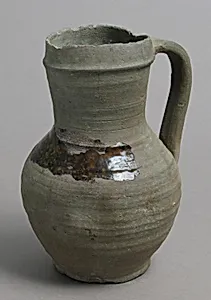
Earthenware, unglazed and partially salt glazed
Dimensions
Overall: 7 3/4 x 5 9/16 x 5 1/16 in. (19.7 x 14.2 x 12.9 cm)
Classification
Ceramics
Culture
German
Department
The Cloisters
Museum
Metropolitan Museum of Art, New York, NY
Credit
The Cloisters Collection, 1995
Accession Number
1995.325
Rights
Public Domain
Art Historical Context
This earthenware jug stands with a rounded, bulbous body that rises to a narrower neck and an open rim. A single sturdy handle curves from the shoulder to the upper neck, while fine horizontal ridges left by the potter’s wheel mark the surface. Its muted gray-green tone is interrupted by irregular patches of brownish salt glaze across the upper body, with areas of wear revealing lighter tones beneath. Crafted in Germany around 1175–1250 by an unknown artist, the jug combines unglazed and partially salt-glazed earthenware, a technique that produced durable, practical vessels for daily use. Its modest form and visible making process reflect the straightforward ceramics of the medieval period. Now in the Cloisters Collection at The Metropolitan Museum of Art, this work invites visitors to appreciate the quiet beauty of functional objects from centuries ago.