
Pitcher
Unknown Artist
1830–70
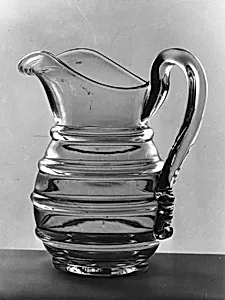
Medium
Blown pattern-molded non-lead glass
Dimensions
H. 9 1/4 in. (23.5 cm)
Classification
Pitcher
Culture
American
Department
The American Wing
Museum
Metropolitan Museum of Art, New York, NY
Credit
Rogers Fund, 1910
Accession Number
10.60.24
Rights
Public Domain
Art Historical Context
This graceful **Pitcher**, crafted between 1830 and 1870 by an unknown American artist, stands as a fine example of everyday elegance from the mid-19th century. 9¼ inches tall, it hails from the Metropolitan Museum of Art's American Wing, acquired through the Rogers Fund in 1910. Made of blown pattern-molded non-lead, it reflects the ingenuity of American glassmakers who produced functional yet decorative household wares during a time of rapid industrialization. The blown pattern-molded technique was a hallmark of this era's glass production. Molten glass was blown into a mold engraved with intricate patterns—often ribs, diamonds, or swirls—creating textured surfaces efficiently without the expense of hand-cutting. Unlike luxurious lead crystal favored by elites, non-lead glass was durable and affordable, ideal for middle-class homes. This method flourished in New England factories, democratizing beauty in daily life. In the American Wing, the Pitcher evokes the hospitality of antebellum and post-Civil War households, where such vessels served water, lemonade, or spirits at the table. Its survival highlights the artistic merit of vernacular objects, bridging utility and aesthetics in early American decorative arts. A testament to anonymous craftsmanship, it invites us to appreciate the quiet sophistication of the everyday.