
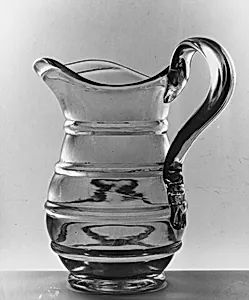
Pitcher
Unknown Artist
1830–70
Medium
Blown pattern-molded non-lead glass
Dimensions
H. 10 in. (25.4 cm); Diam. 6 in. (15.2 cm)
Classification
Pitcher
Culture
American
Department
The American Wing
Museum
Metropolitan Museum of Art, New York, NY
Credit
Rogers Fund, 1910
Accession Number
10.60.25
Rights
Public Domain
Art Historical Context
This graceful pitcher, crafted by an unknown American artist between 1830 and 1870, stands as a fine example of everyday artistry from the early industrial era. Measuring 10 inches tall and 6 inches in, it was made from blown pattern-molded non-lead—a technique that allowed glassmakers to create intricate, textured designs efficiently by blowing molten glass into patterned molds. Unlike luxurious lead crystal, non-lead glass was more affordable and durable, making it ideal for household use. Housed in The Metropolitan Museum of Art's American Wing and acquired through the Rogers Fund in 1910, the pitcher reflects the burgeoning glass industry in 19th-century America. During this period of rapid manufacturing growth, such objects adorned middle-class dining tables, blending functionality with subtle ornamentation. The pattern-molding process produced repeating motifs—often geometric or floral—that added visual appeal without the high cost of hand-blown decoration. Today, this unassuming vessel offers a window into American domestic life, highlighting how ordinary items became vessels of craftsmanship and cultural pride. Visitors can appreciate its tactile quality and historical charm up close.