
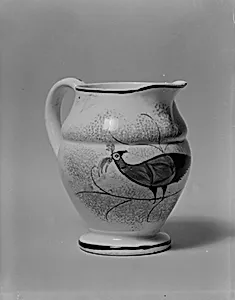
Pitcher
Unknown Artist
1800–1830
Medium
Earthenware, spatterware
Dimensions
H. 3 1/2 in. (8.9 cm)
Classification
Pitcher
Culture
British (American market)
Department
The American Wing
Museum
Metropolitan Museum of Art, New York, NY
Credit
Bequest of Helen Hay Whitney, 1944
Accession Number
45.35.29
Rights
Public Domain
Tags
Art Historical Context
This charming earthenware pitcher, crafted between 1800 and 1830 by an unknown British artist for the American market, exemplifies folk art tradition of spatterware. just 3½ inches tall, its petite scale suggests it may have served as a toy, a small table accessory, or a decorative trinket in early American households. Adorned with bird motifs—evident from its tags—the pitcher features the distinctive spatterware technique, where pigments are flicked or sponged onto the unglazed surface before firing, creating vibrant, splattered patterns that evoke a playful, handcrafted whimsy. Spatterware emerged in 18th-century England as an affordable alternative to pricier ceramics like Wedgwood, gaining popularity through exports to America during the Federal period. This pitcher reflects transatlantic trade networks, bringing British ingenuity to burgeoning U.S. homes amid growing demand for colorful, everyday pottery. Housed in The Metropolitan Museum of Art's American Wing, it highlights how such humble objects bridged cultures, offering insight into domestic life when mass-produced goods were scarce. Bequeathed by Helen Hay Whitney in 1944, this piece invites visitors to appreciate the artistry in simplicity—its earthy tones and lively birds capturing the era's unpretentious joy.