
Pitcher
Unknown Artist
1830–70
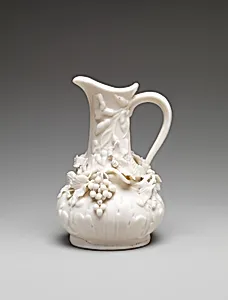
Medium
Parian porcelain
Dimensions
4 3/8 x 3 1/8 x 3 1/4 in. (11.1 x 7.9 x 8.3 cm)
Classification
Pitcher
Culture
American
Department
The American Wing
Museum
Metropolitan Museum of Art, New York, NY
Credit
Gift of Dr. Charles W. Green, 1947
Accession Number
47.90.19
Rights
Public Domain
Tags
Art Historical Context
This delicate **Pitcher**, crafted between 1830 and 1870, exemplifies American Parian porcelain—a fine, unglazed bisque ware prized for its smooth, marble-like texture that mimicked costly Parian marble sculptures. Standing just 4⅜ inches tall, this petite vessel from an unknown American artist likely served both practical and decorative purposes in middle-class homes, blending everyday utility with elegant ornamentation. The grapes motif, suggested by its tagging, evokes themes of abundance and the vine, a popular neoclassical symbol in 19th-century design. Parian porcelain emerged in the mid-19th century as an accessible luxury, produced by potteries like those in Bennington, Vermont, and East Liverpool, Ohio. Its matte finish highlighted intricate molding techniques, allowing for lifelike details without the sheen of glazed ceramics. This piece reflects the era's growing American industry, fueled by industrialization and a taste for refined, European-inspired goods amid expanding domestic markets. Generously gifted to the Metropolitan Museum of Art in 1947 by Dr. Charles W. Green, the pitcher now resides in The American Wing, offering a tangible glimpse into antebellum and post-Civil War domestic life. Visitors will appreciate its subtle craftsmanship, a testament to the ingenuity of overlooked artisans shaping everyday beauty.