
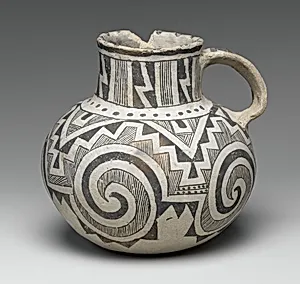
Pitcher
Unknown Artist
12th–13th century
Medium
Clay
Dimensions
H. 6 3/8 × W. 8 3/8 × D. 8 9/16 in. (16.2 × 21.3 × 21.7 cm)
Classification
Ceramics-Vessels
Culture
Ancestral Puebloan (Cibola)
Department
Arts of Africa, Oceania, and the Americas
Museum
Metropolitan Museum of Art, New York, NY
Credit
Gift of Samuel and Gabrielle Lurie, in celebration of the Museum's 150th Anniversary, 2019
Accession Number
2019.565.3
Rights
Public Domain
Art Historical Context
This elegant clay pitcher, crafted by an unknown Ancestral Puebloan artist from Cibola region during the 12th–13th century, exemplifies the sophisticated ceramics of the American Southwest. Standing at 6 3/8 inches tall with a wide, practical form (H. 6 3/8 × W. 8 3/8 × D. 8 9/16 in.), it served as a vessel for storing or pouring water, food, or ritual liquids in daily life. Housed in the Metropolitan Museum of Art's Department of Arts of Africa, Oceania, and the Americas, it was generously gifted by Samuel and Gabrielle Lurie in 2019 to celebrate the museum's 150th anniversary. Ancestral Puebloans, ancestors of modern Pueblo peoples, thrived in the Four Corners area, building cliff dwellings and fostering intricate trade networks. Pottery like this pitcher was central to their culture, symbolizing both utility and artistry. Produced through coiling and hand-building techniques, these vessels were often fired in open pits to achieve durable, earthen tones, reflecting a deep connection to the land's clay resources. Its survival highlights the enduring legacy of Cibola potters, whose work bridged functionality and subtle aesthetic beauty amid a time of environmental challenges and cultural flourishing. A quiet testament to pre-Columbian ingenuity, this piece invites us to ponder the hands that shaped it centuries ago.