
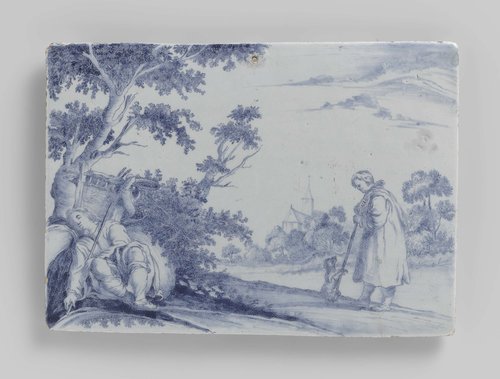
plaat van faïence met herdersscène
ca. 1750 - ca. 1775
Dimensions
27; 20
Rights
Public Domain
About this artwork
plaat van faïence. Blauw beschilderd met een herdersscene.
Art Historical Context
This charming tin-glazed earthenware plate, known as *Plaat van faïence met herdersscène*, dates to around 1750–1775. Measuring 20 cm high by 27 cm wide, it features a delicate blue-painted shepherd scene, evoking the pastoral idylls so beloved in 18th-century Europe. Anonymous artisans crafted such pieces in workshops, likely in the Netherlands, where faïence—earthenware coated with a glossy tin glaze—served as an accessible alternative to expensive Chinese porcelain. The blue decoration, achieved through cobalt oxide applied under the glaze before firing, was a hallmark technique of Delftware production. This method ensured vibrant, durable colors that wouldn't fade with use, making the plate both functional tableware and a decorative treasure. Shepherd scenes like this one drew from Rococo tastes, romanticizing rural life with idyllic figures amid landscapes, reflecting a cultural nostalgia for simpler times amid urban growth. As a snapshot of everyday luxury, this piece highlights the democratizing power of ceramics in the Enlightenment era, blending artistry with utility for middle-class homes. Visitors will appreciate its timeless whimsy and the enduring appeal of blue-and-white traditions.
About the Artist
anonymous
In the vast tapestry of art history, "Anonymous" stands not as a singular individual but as a collective designation for countless unidentified creators whose works have endured across millennia. These artists, spanning prehistoric cave painters to medieval illuminators and folk craftsmen, produced the foundational layers of human visual culture. Prior to the Renaissance, when individual fame emer...