
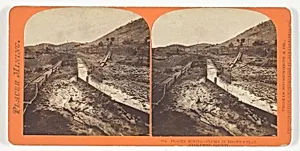
Placer Mining, Flume in Brown's Flat, Tuolumne County, No. 970 from the series "Placer Mining"
Medium
Albumen print, stereo
Dimensions
Each image: 8 × 7.8 cm (3 3/16 × 3 1/8 in.); Card: 8.7 × 17.6 cm (3 7/16 × 6 15/16 in.)
Classification
stereograph (albumen)
Department
Photography and Media
Museum
Art Institute of Chicago
Accession Number
108770
Rights
Public Domain
Art Historical Context
Step into the rugged world of California's Gold Rush aftermath with *Placer Mining, Fl in Brown's Flat, Tuolumne County*, No. 970 from Houseworth and Company's *Placer Mining* seriesc. 1868). This stereograph, an albumen print mounted on a card, captures the ingenuity of 19th-century miners at work. Viewed through a stereoscope, the paired images create a vivid three-dimensional scene of a wooden flume—a sloping water channel—snaking through the Sierra Nevada landscape in Tuolumne County. Houseworth's San Francisco firm specialized in such documentary photography, producing thousands of stereographs to showcase the American West's industrial boom. Placer mining, the method depicted here, involved channeling water to wash gold-bearing gravel, a technique that fueled the 1849 Gold Rush and sustained California's economy well into the 1860s. Brown's Flat was a bustling site in this era, symbolizing the transformative rush for riches that drew over 300,000 prospectors and reshaped the frontier. These images not only preserved fleeting industrial feats but also romanticized the West for Eastern audiences, boosting tourism and settlement. Artistically, the albumen process delivered sharp details and rich tones from glass negatives, making stereographs a revolutionary medium for immersive storytelling. Housed in the Art Institute of Chicago's Photography and Media department, this 8 × 7.8 cm gem invites us to ponder the human drive for discovery amid nature's raw power.