
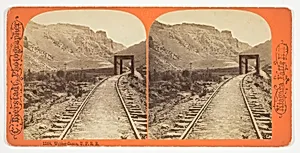
Webber Canon, U.P.R.R.
1863/1903
Medium
Albumen print, stereo
Dimensions
Each image: 8 × 7.5 cm (3 3/16 × 3 in.); Card: 8.6 × 17.6 cm (3 7/16 × 6 15/16 in.)
Classification
stereograph (albumen)
Department
Photography and Media
Museum
Art Institute of Chicago
Accession Number
108766
Rights
Public Domain
Art Historical Context
Charles Bierstadt’s “Webber Canon, U.P.R.R.” is a striking stereograph that captures the rugged grandeur of the American West during the height of transcontinental railroad construction. Created as an albumen print between the 1860s and early 1900s, the paired images were designed to be viewed through a stereoscope, producing a vivid three-dimensional effect that brought distant landscapes into intimate focus for armchair travelers. Bierstadt, brother of the celebrated Hudson River School painter Albert Bierstadt, specialized in such photographic views that combined artistic sensibility with documentary precision. Albumen prints, made by suspending silver salts in egg-white emulsion on paper, were the dominant photographic medium of the nineteenth century and prized for their rich tonal range and fine detail. The stereograph format itself was a cultural phenomenon, allowing millions of viewers to experience the drama of places like Utah’s Weber Canyon without leaving their parlors. By framing the canyon’s sheer walls alongside the newly laid Union Pacific tracks, Bierstadt’s image celebrates both natural majesty and human engineering ambition. Today, this work in the Art Institute of Chicago’s collection offers a window onto photography’s early role in shaping national identity and westward expansion. Its modest scale belies the way such images helped Americans visualize—and ultimately claim—their expanding frontier.