
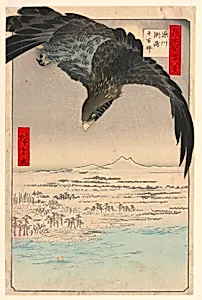
Plain at Suzaki Fukagawa (Fukagaw Susaki, Juman-tsubo) From the Series One hundred Views of Edo
Classification
landscapes
Department
Smithsonian Collection
Museum
Smithsonian American Art Museum
Credit
Gift of the Estate of Mrs. Robert H. Patterson
Accession Number
1941-31-285
Rights
Public Domain
About this artwork
Research in Progress
Art Historical Context
Ando Hiroshige’s “Plain at Suzaki Fukagawa (Fukagaw Susaki, Juman-tsubo)” belongs to his celebrated series One Hundred Famous Views of Edo, created in 1857 during the final years of the Edo period. As one of Japan’s foremost ukiyo-e masters, Hiroshige specialized in capturing the shifting seasons and everyday landscapes around the bustling capital, using delicate lines and atmospheric color to evoke a sense of place and transience. This print depicts the open marshlands and tidal flats of the Suzaki area, where urban life gradually gave way to nature. The scene reflects the era’s fascination with both the rapid growth of Edo and the quiet beauty of its outskirts, offering viewers a poetic glimpse of a city on the brink of modernization. Hiroshige’s series remains one of the most influential print projects in Japanese art history, admired for its inventive compositions and ability to blend human activity with the natural world. Today the work resides in the Smithsonian American Art Museum, where it continues to introduce audiences to the rich visual poetry of nineteenth-century Japan.