
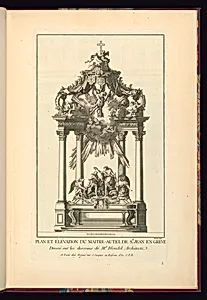
PLAN ET ÉLÉVATION DU MAITRE-AUTEL DE ST.JEAN EN GREVE
Classification
Department
Smithsonian Collection
Museum
Smithsonian American Art Museum
Credit
Purchased for the Museum by the Advisory Council
Accession Number
1921-6-398-2
Rights
Public Domain
About this artwork
Research in Progress
Art Historical Context
Jacques-François Blondel’s print offers a precise architectural study of the high altar at Saint-Jean-en-Grève, a historic Parisian church. Created sometime during the architect’s long career from 1713 to 1774, the work presents both a ground plan and an elevation, allowing viewers to understand the altar’s spatial design and decorative details. As a print, it served as an important means of sharing architectural ideas across Europe at a time when such drawings helped shape public taste and professional practice. Blondel, a leading French architectural theorist and educator, played a key role in the transition toward neoclassical principles. His careful documentation of existing monuments like this altar reflects the Enlightenment-era interest in preserving and studying France’s built heritage. Though the original medium of this particular print remains unknown, its crisp lines and measured proportions reveal the technical skill required to translate three-dimensional stonework into two-dimensional form. Acquired by the Smithsonian American Art Museum through its Advisory Council, the sheet invites modern visitors to appreciate how 18th-century architects balanced reverence for tradition with a desire for clarity and order. Research continues on this intriguing work, promising further insights into Blondel’s methods and the lost interior of Saint-Jean-en-Grève.