
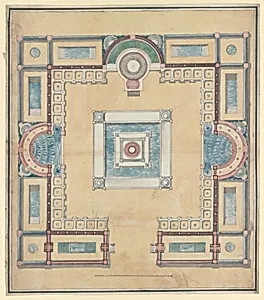
Plan for a Menagerie
ca. 1783
Medium
Pen and black ink, watercolor
Dimensions
20 5/8 x 17 15/16 in. (52.4 x 45.6 cm)
Classification
Drawings|Ornament & Architecture
Department
Drawings and Prints
Museum
Metropolitan Museum of Art, New York, NY
Credit
Gift of Mr. and Mrs. Charles Wrightsman, 1970
Accession Number
1970.736.66
Rights
Public Domain
Art Historical Context
**Plan for a Menagerie***Charles Percier,. 1783* Pen and black ink,, 20 5/8 x 17 15/16 in. (52.4 x 45.6 cm) The Metropolitan Museum of Art, York Step into the imaginative world of late 18th-century France with Charles Percier's *Plan for a Menagerie a delicate architectural drawing created around 1783. At just 19, Percier—later a leading neoclassical designer famed for his work with Pierre Fontaine on Napoleonic interiors—sketched this elegant blueprint for an exotic animal enclosure. Rendered in precise pen and black ink with vibrant watercolor washes, the sheet captures a fanciful pavilion surrounded by gardens, evoking the aristocratic passion for menageries as symbols of wealth and wonder. This work exemplifies the neoclassical emphasis on symmetry, proportion, and classical ornament, blending functional architecture with decorative flair. Percier's meticulous ink lines define structural elements like arches and enclosures, while watercolor adds atmospheric depth and subtle color to foliage and pavilions—techniques prized in academic training at Paris's École des Beaux-Arts. Produced on the eve of the French Revolution, it reflects Enlightenment-era curiosity about nature and global exploration, when private zoos showcased imported rarities. A generous gift from Mr. and Mrs. Charles Wrightsman in 1970, this drawing highlights Percier's early promise and the enduring allure of ornamental architecture. Visitors will appreciate its blend of practicality and fantasy, a window into a bygone era's splendor.
About the Artist
Charles Percier · 1764–1838
Charles Percier (1764–1838) rose from humble origins in Paris, where his mother laundered for Marie-Antoinette and his father served as a porter at the Tuileries Palace, to become one of France's most influential neoclassical architects and designers. From age twelve, he attended a free drawing school for indigent students, honing his skills in the studio of painter Louis-Jean-François Lagrenée be...