
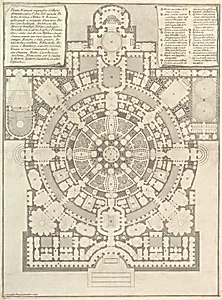
Plan of a spacious and magnificent College designed after the ancient gymnasia of the Greeks and the baths of the Romans..., from "Opere Varie di Architettura, prospettive, grotteschi, antichità; inventate, ed incise da Giambattista Piranesi Architetto Veneziano" (Various Works of Architecture, perspectives, grotesques and antiquities; designed and etched by Giambattista Piranesi, Venetian Architect)
Medium
Etching, engraving, drypoint; second state of seven (Robison)
Dimensions
Sheet: 25 1/16 x 19 1/2 in. (63.6 x 49.5 cm) Plate: 23 11/16 x 17 1/2 in. (60.2 x 44.5 cm)
Classification
Prints
Department
Drawings and Prints
Museum
Metropolitan Museum of Art, New York, NY
Credit
Harris Brisbane Dick Fund, 1937
Accession Number
37.45.3(20)
Rights
Public Domain
Tags
Art Historical Context
Giovanni Battista Piranesi’s 1750 etching presents an ambitious architectural plan for an ideal college, drawing inspiration from the communal spaces of ancient Greek gymnasia and the grand public baths of Rome. Created as part of his “Opere Varie,” a series of inventive prints celebrating classical antiquity, the work reflects the mid-eighteenth-century fascination with reimagining ancient structures for modern educational purposes. Piranesi, a Venetian architect and printmaker, merges scholarly precision with imaginative vision, proposing a magnificent campus that would foster both physical and intellectual development. Executed in etching, engraving, and drypoint, the print showcases Piranesi’s mastery of line and tonal depth, allowing intricate architectural details to emerge with remarkable clarity. As the second state of seven, it reveals his careful refinement of the composition. The medium itself was significant in the period, enabling wide dissemination of architectural ideas across Europe and influencing neoclassical designers who sought to revive the grandeur of the classical past. Displayed today at the Metropolitan Museum of Art, this sheet underscores Piranesi’s role in shaping Enlightenment-era views of antiquity—not merely as ruins to admire, but as living models for contemporary society. Its emphasis on harmonious, spacious design continues to invite viewers to consider how architecture can embody cultural ideals.
About the Artist
Giovanni Battista Piranesi|Giovanni Bouchard · 1720–1778
Giovanni Battista Piranesi (1720–1778) was an Italian printmaker, architect, and antiquarian whose visionary etchings of Rome and imaginary prisons revolutionized architectural representation and profoundly influenced both Neoclassicism and Romanticism. Piranesi stands as one of the most important printmakers of the eighteenth century, fundamentally shaping European perceptions of ancient Rome an...