
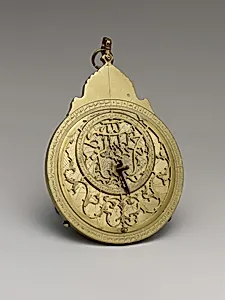
Planispheric Astrolabe
dated A.H. 1065/ 1654–55 CE
Medium
Brass and steel; cast and hammered, pierced and engraved
Dimensions
H. 8 1/2 in. (21.6 cm) W. 6 3/4 in. (17.1 cm) D. 2 1/4 in. (5.7 cm)
Classification
Metal
Department
Islamic Art
Museum
Metropolitan Museum of Art, New York, NY
Credit
Harris Brisbane Dick Fund, 1963
Accession Number
63.166a–j
Rights
Public Domain
Art Historical Context
This exquisite planispheric astrolabe, crafted in 1654–55 by the Persian instrument maker Muhammad Zaman al-Munajjim al-Asturlabi, represents the pinnacle of Islamic scientific artistry. Used to measure the positions of celestial bodies, determine prayer times, and aid navigation, the astrolabe embodies the deep integration of astronomy and faith in the Islamic world. Its elegant brass and steel construction, featuring intricate piercing and engraving, allowed scholars and navigators to solve complex astronomical problems with remarkable precision. The artist’s name, incorporating the titles “astronomer” and “astrolabe maker,” highlights the specialized expertise required for such instruments. Created during the Safavid period, this piece reflects centuries of refinement in mathematical and metallurgical traditions across the Islamic world. The careful hammering, casting, and decorative engraving transform a functional tool into an object of beauty, where geometric patterns and Arabic inscriptions celebrate both knowledge and craftsmanship. Today housed in the Metropolitan Museum of Art’s Islamic Art collection, the astrolabe invites viewers to appreciate how science and art converged in the 17th century, serving as a bridge between earthly observation and the heavens.