
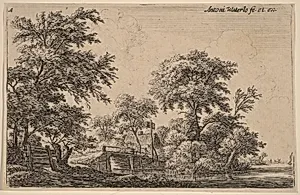
Planks Attached to Four Trees
1601 to 1650
Medium
etching
Classification
Department
CG-E
Museum
National Gallery of Art, Washington, D.C.
Credit
Rosenwald Collection
Accession Number
1946.11.210
Rights
Public Domain
Art Historical Context
In the serene world of 17th-century Dutch printmaking, Anthonie Waterloo's *Planks Attached to Four Trees (ca. 1601–1650) captures the artist's fascination with nature's raw forms. A master etcher from Haarlem, contributed to the Dutch Golden Age celebration of landscapes, where everyday scenes of trees and woodlands evoked a sense of quiet introspection. This etching, housed in the National Gallery of Art's Rosenwald Collection (Department CG-E), showcases his skill in rendering the rugged beauty of bark and branch. Etching, Waterloo's preferred medium, involved coating a copper plate with acid-resistant ground, scratching designs into it, and immersing it in acid to etch fine lines—perfect for the intricate textures of foliage and wood grain. Here, the title suggests a playful yet observational study: four sturdy trees linked by horizontal planks, perhaps evoking rural construction or a meditation on harmony between human intervention and the natural world. Such motifs highlight the era's growing appreciation for detailed nature studies, influenced by artists like Rembrandt. As part of the esteemed Rosenwald Collection of prints, this work exemplifies the technical innovation and poetic subtlety of Dutch etching, inviting visitors to ponder the enduring allure of simple, arboreal vignettes.
About the Artist
Anthonie Waterloo · 1609–1690
Anthonie Waterloo (1609–1690) was a prominent Dutch Golden Age landscape artist, born on May 6 in Lille, then part of the Spanish Netherlands. Little is known of his early life beyond his mother, Magdalena Vaillant, who joined Amsterdam's Walloon Church in 1621, with Waterloo following in 1630; no records exist of formal training, and he was likely self-taught. Registered as a painter in Amsterdam...