
Plaque
Unknown Artist
second half 13th century
Medium
Bronze; drilled
Dimensions
H. 2 1/16 in. (5.3 cm) W. 2 1/2 in. (6.4 cm) D. 1/8 in. (0.3 cm) Wt. 0.9 oz. (25.5 g)
Classification
Metal
Department
Islamic Art
Museum
Metropolitan Museum of Art, New York, NY
Credit
Purchase, Mr. and Mrs. Jerome A. Straka Gift, 1971
Accession Number
1971.88
Rights
Public Domain
Tags
Art Historical Context
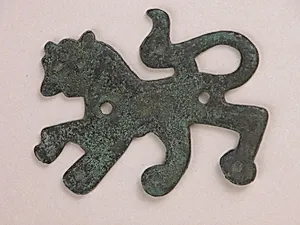
This delicate bronze plaque, crafted by an unknown artist in the half of the 13 century, hails from the vibrant world of Islamic art. Measuring just over 2 inches wide and tall, its petite scale—barely the size of a modern coaster—suggests it served as a decorative appliqué, perhaps adorning jewelry, belts, harnesses, or furniture. The "drilled" technique indicates precise holes were bored through the thin metal (only 1/8 inch deep), allowing it to be riveted or sewn onto leather or fabric, a practical yet elegant method common in medieval Islamic metalworking. Animal motifs, hinted at by its tags, were a hallmark of 13th-century Islamic decorative arts, drawing from both nomadic traditions and urban workshops across regions like Syria, Egypt, or Persia under Mamluk or Ilkhanid patronage. Bronze, valued for its durability and golden sheen, was often cast or hammered into intricate designs celebrating the natural world—evoking grace, power, or spiritual symbolism without direct figural representation. This plaque exemplifies the era's masterful blend of functionality and artistry, where everyday objects became miniature masterpieces. Today, at The Metropolitan Museum of Art (purchased in 1971), it invites us to marvel at the ingenuity of anonymous artisans whose work bridged cultures along Silk Road trade routes. A tiny window into medieval Islamic life, it reminds us how art thrived in the details.