
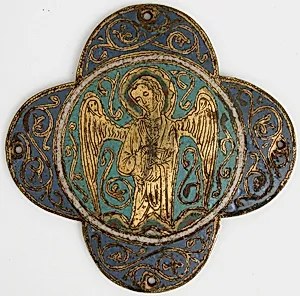
Plaque
Unknown Artist
13th century
Medium
Champlevé enamel, copper
Dimensions
Overall: 5 1/8 x 5 1/8 x 1/16 in. (13 x 13 x 0.2 cm)
Classification
Enamels-Champlevé
Culture
French
Department
Medieval Art
Museum
Metropolitan Museum of Art, New York, NY
Credit
Gift of J. Pierpont Morgan, 1917
Accession Number
17.190.810
Rights
Public Domain
Art Historical Context
This exquisite 13th-century French, crafted by an unknown artist, exemplifies the mastery of champlevé enamel on copper—a technique that flourished in medieval Europe, particularly in workshops around Limoges. Measuring just 5 1/8 x 5 1/8 inches and remarkably thin at 1/16 inch, its petite scale suggests it may have adorned a larger object, such as a reliquary, book cover, or liturgical item, blending functionality with luminous beauty. Champlevé, meaning "raised field" in French, involved carving channels into the copper base, filling them with powdered glass enamels in vibrant colors, and firing to fuse them into a durable, jewel-like surface. This method allowed artisans to create intricate designs with striking contrast, capturing the era's Gothic emphasis on light, color, and spiritual symbolism. Popular from the 12th to 14th centuries, these enamels were prized for their affordability compared to precious metals, making religious art accessible to churches and nobility alike. A generous gift from J. Pierpont Morgan in 1917, this plaque now graces the Metropolitan Museum of Art's Medieval Art collection. It offers visitors a window into the innovative craftsmanship of medieval France, where metalwork met alchemy to produce timeless treasures that still shimmer with medieval splendor.