
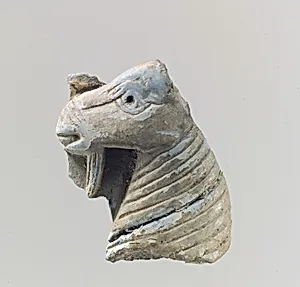
Plaque fragment
Unknown Artist
ca. 9th–8th century BCE
Medium
Ivory
Dimensions
0.63 x 1.06 in. (1.6 x 2.69 cm)
Classification
Ivory/Bone-Reliefs
Culture & Period
Assyrian · Neo-Assyrian
Department
Ancient Near Eastern Art
Museum
Metropolitan Museum of Art, New York, NY
Credit
Rogers Fund, 1957
Accession Number
57.27.17
Rights
Public Domain
Tags
Art Historical Context
This delicate ivory plaque fragment, dating to the Neo-Assyrian period (ca. 9th–8th century BCE), offers a glimpse into the opulent world of ancient Assyrian artistry. Crafted by an unknown artist, this tiny relief—measuring just 0.63 x 1.06 inches—was likely part of a larger decorative ensemble, such as furniture inlays or palace furnishings from the mighty Assyrian Empire. The tag "Animals" hints at motifs typical of Assyrian ivories, where creatures symbolized power, fertility, or the natural world under divine rule. Ivory, a prized luxury material imported from distant regions like India or Africa, was carved with remarkable precision in low relief, showcasing the Neo-Assyrian mastery of intricate detail in miniature scale. These techniques allowed for dynamic scenes that brought elite spaces to life, blending realism with stylized forms characteristic of Near Eastern art. Such fragments, unearthed from royal contexts, underscore the empire's wealth and cultural sophistication during its imperial peak. Today, housed in the Metropolitan Museum of Art's Department of Ancient Near Eastern Art (Rogers Fund, 1957), this piece invites us to marvel at the enduring finesse of Assyrian craftsmen, whose work influenced generations of artists across the ancient world.