
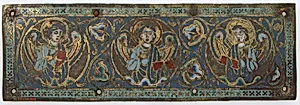
Plaque from a Chasse
Unknown Artist
13th century
Medium
Champlevé enamel, copper-gilt
Dimensions
Overall: 2 15/16 x 8 7/8 x 1/16 in. (7.4 x 22.5 x 0.2 cm)
Classification
Enamels-Champlevé
Culture
French
Department
Medieval Art
Museum
Metropolitan Museum of Art, New York, NY
Credit
Gift of J. Pierpont Morgan, 1917
Accession Number
17.190.808
Rights
Public Domain
Art Historical Context
This exquisite *Plaque from a Ch*, crafted in 13th-century France, offers a glimpse into the opulent world of medieval religious art. using the champlevé enamel technique on a copper-gilt base, it measures a delicate 2 15/16 x 8 7/8 inches, perfect for adorning a *chasse*—a box-like reliquary shaped like a miniature church or house, designed to house sacred relics such as saints' bones. These plaques, often arranged in narrative scenes on the reliquary's surfaces, were prized possessions of churches and nobility, blending artistry with profound spiritual purpose. Champlevé enamel, a hallmark of Gothic-era workshops (especially in Limoges), involved carving troughs into the metal, filling them with finely ground glass powders in vibrant colors, and firing them to fuse into a glassy, gem-like surface. This labor-intensive method created durable, luminous panels that captured light beautifully, symbolizing divine radiance. The gilding added a regal glow, elevating the plaque's status as a devotional treasure. Gifted to the Metropolitan Museum of Art by J. Pierpont Morgan in 1917, this anonymous masterpiece highlights French medieval innovation in enameling, a craft that rivaled goldsmithing in prestige. It invites us to ponder the era's fervent faith, where such objects bridged the earthly and the eternal.