
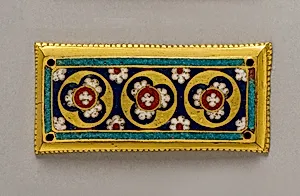
Plaque from a Reliquary
early 13th century
Medium
Champlevé and cloisonné enamel, copper-gilt
Dimensions
Overall: 3 1/2 x 1 5/8 x 3/8 in. (8.9 x 4.1 x 0.9 cm)
Classification
Enamels
Culture
German
Department
The Cloisters
Museum
Metropolitan Museum of Art, New York, NY
Credit
The Cloisters Collection, 1969
Accession Number
69.238.2
Rights
Public Domain
Tags
Art Historical Context
This delicate plaque, created by the anonymous Master of the Virgin Mary's Relary Casket in early13th-century Germany, adorned a reliquary—a sacred container for holy relics like saints' bones or fragments of True Cross. Measuring just 3½ by 1½ inches, its diminutive scale belies its grandeur, showcasing the pinnacle of medieval enamel artistry on a copper-gilt base. Housed in The Cloisters at the Metropolitan Museum of Art, it exemplifies the German tradition of devotional metalwork during the High Middle Ages. The plaque employs two sophisticated enameling techniques: *champlevé*, where cells are carved into the metal and filled with fused colored glass, and *cloisonné*, using fine gold wires to create compartments for enamel. These methods, perfected in regions like the Rhineland, allowed for vibrant, jewel-like colors and intricate details that mimicked illuminated manuscripts or stained glass. Reliquaries like this were pilgrimage treasures, believed to channel divine power and inspire faith amid the era's fervent Marian devotion. As a fragment of a larger casket dedicated to the Virgin Mary, this piece highlights the fusion of technology, piety, and beauty in Gothic-era craftsmanship. Its survival speaks to the enduring allure of medieval religious art, inviting us to marvel at the devotion poured into objects small enough to hold in the palm of a hand.