
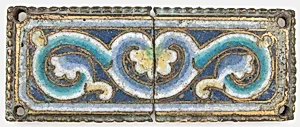
Plaque from a Reliquary Shrine
Unknown Artist
ca. 1170
Medium
Champlevé enamel, copper alloy, gilt
Dimensions
Overall: 2 11/16 x 1 1/16 x 1/8 in. (6.8 x 2.7 x 0.3 cm) a: 1 5/16 x 1 1/16 x 1/8 in. (3.4 x 2.7 x 0.3 cm) b: 1 5/16 x 1 1/16 x 1/8 in. (3.4 x 2.7 x 0.3 cm)
Classification
Enamels-Champlevé
Culture
German
Department
Medieval Art
Museum
Metropolitan Museum of Art, New York, NY
Credit
Gift of J. Pierpont Morgan, 1917
Accession Number
17.190.2138a, b
Rights
Public Domain
Art Historical Context
This exquisite plaque, dating to around 1170, hails from a German reliquary shrine—a sacred container for housing holy relics venerated in medieval Christian devotion. Crafted by an unknown artist during the Romanesque era, it exemplifies the spiritual artistry of 12th-century Europe, where such objects adorned churches and monasteries to inspire awe and piety among the faithful. Its petite size (just over 2½ by 1 inches) suggests it was one of many panels forming a larger decorative ensemble, now preserved in the Metropolitan Museum of Art thanks to a 1917 gift from J. Pierpont Morgan. The plaque's brilliance comes from champlevé enamel, a sophisticated technique where channels are engraved into a copper alloy base, filled with powdered glass colors, and fired to create vibrant, durable surfaces often enhanced with gilding. Thriving in medieval workshops, this method allowed for intricate designs that captured biblical scenes or saints with luminous intensity, bridging metalwork and painting traditions. In German medieval culture, reliquaries like this were central to pilgrimage and ritual, symbolizing divine presence amid feudal society's uncertainties. Though details of its imagery are not specified here, such plaques often depicted apostles or miracles, reflecting the era's fusion of craftsmanship and faith that continues to captivate modern viewers.