
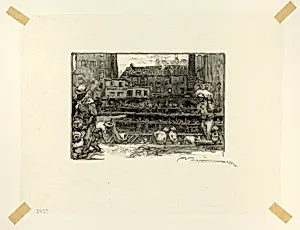
Plaster Unloaders, plate three from Le Long de la Seine et des Boulevards
1890, published 1910
Medium
Wood engraving in black on cream Japanese tissue
Dimensions
Image: 7.8 × 11.2 cm (3 1/8 × 4 7/16 in.); Sheet: 14.8 × 19.2 cm (5 7/8 × 7 9/16 in.)
Classification
wood engraving
Department
Prints and Drawings
Museum
Art Institute of Chicago
Accession Number
79187
Rights
Public Domain
Art Historical Context
In the bustling world of late 19th-century Paris Louis Auguste Lepère captured the vitality of urban life through his masterful wood engravings.Plaster Unloaders plate three from the seriesLe Long de la Seine des Boulevards*1890, published 1910), laborers at work along the Seine River, unloading heavy sacks of plaster from boats onto the quays. Lepère, a leading French printmaker of his era, celebrated the everyday heroism of workers amid the city's transformation during the Belle Époque, evoking the rhythm of commerce and industry that defined Haussmann's modernized Paris. Rendered as a wood engraving in black ink on delicate cream Japanese tissue—a thin, luxurious paper prized for its absorbency and subtle texture—this intimate print (image: 7.8 × 11.2 cm) showcases Lepère's technical virtuosity. Wood engraving allowed for precise, intricate lines that convey texture, motion, and atmospheric depth, rivaling the detail of paintings. The choice of Japanese tissue nods to the Japonisme trend influencing European artists, lending the work a luminous, almost ethereal quality despite its earthy subject. Housed in the Art Institute of Chicago's Prints and Drawings department, this piece highlights Lepère's role in revitalizing printmaking as fine art. It invites viewers to pause and appreciate the unsung labor that fueled Paris's grandeur, bridging art and social history in a single, evocative frame.
About the Artist
Louis Auguste Lepère · 1849–1918
Louis-Auguste Lepère (1849–1918) was born in Paris on November 30 to the sculptor François Lepère, immersing him early in the artistic world. At age thirteen, he apprenticed in the studio of the English wood engraver Joseph Burn-Smeeton, training there from 1862 to 1867, and later attended drawing courses under Horace Lecoq de Boisbaudran at the Petite École (now École nationale supérieure des art...