
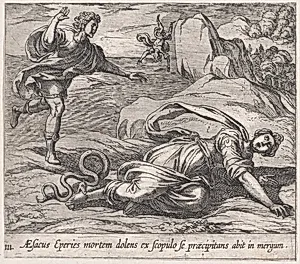
Plate 111: Aesacus and Hespeia (Aesacus Eperies mortem dolens ex scopulo se praecipitans abit in mergum), from Ovid's 'Metamorphoses'
1606
Medium
Etching
Dimensions
Sheet: 3 15/16 × 4 1/2 in. (10 × 11.5 cm)
Classification
Prints
Department
Drawings and Prints
Museum
Metropolitan Museum of Art, New York, NY
Credit
The Elisha Whittelsey Collection, The Elisha Whittelsey Fund, 1951
Accession Number
51.501.3962
Rights
Public Domain
Tags
Art Historical Context
Behold Plate 111 from Antonio Tempesta's masterful 1606 etching series illustrating Ovid's *Metamorph*, a cornerstone of classical mythology. Tempesta, a prolific Florentine artist of the late Renaissance and early Baroque, captured the tragic tale of Aesacus, son of King Priam of Troy. Mourning the death of his beloved Hespeia—slain by a serpent during their pursuit—Aesacus hurls himself from a rocky cliff into the sea. In Ovid's transformative narrative, the god Neptune spares him by metamorphosing the prince into a merganser, a diving bird forever skimming the waves. This intimate etching, measuring just under 4 by 4½ inches, exemplifies Tempesta's virtuosic technique in printmaking. Using fine lines and cross-hatching, he evokes dramatic motion and emotion: Aesacus mid-leap, Hespeia's lifeless form, and coiled snakes symbolizing fate's cruel bite. Produced during a revival of interest in ancient texts, these prints were affordable disseminations of myth for scholars and collectors, bridging antiquity with the vibrant artistic culture of 17th-century Europe. Housed in The Metropolitan Museum of Art's Elisha Whittelsey Collection, this work highlights etching's role in democratizing high art, inviting us to ponder love, loss, and metamorphosis—timeless themes that still resonate today.
About the Artist
Antonio Tempesta · 1555–1630
Antonio Tempesta (1555–1630), known as 'Il Tempestino,' was a Florentine painter and printmaker whose extraordinary output of approximately 1,700 etchings made him one of the most influential printmakers of the early Baroque period. Born in Florence and trained under Santi di Tito and the Flemish master Joannes Stradanus, he enrolled in the Accademia del Disegno in 1576 before relocating to Rome i...