
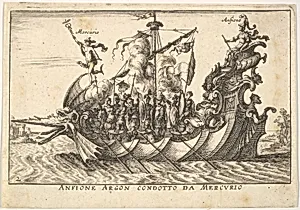
Plate 2: The Argonaut Amphion led by Mercury (Anfione Argon. condotto da Mercurio), with a fantastic beast head at the prow and Amphion seated at the stern, from the series 'The magnificent pageant on the river Arno in Florence for the marriage of the Grand Duke' (Le Magnifique carousel fait sur le fleuve de l'Arne a Florence, pour le mariage du Grand Duc), for the wedding celebration of Cosimo de' Medici in Florence, 1608
Medium
Etching; reverse copy
Dimensions
Sheet (Trimmed): 3 11/16 × 5 1/4 in. (9.4 × 13.4 cm)
Classification
Prints|Ornament & Architecture
Department
Drawings and Prints
Museum
Metropolitan Museum of Art, New York, NY
Credit
Bequest of Phyllis Massar, 2011
Accession Number
2012.136.527.3
Rights
Public Domain
Tags
Art Historical Context
This enchanting etching, *Plate 2: The Argonaut Amphion led by*, captures a highlight from the lavish 1608 wedding celebrations of Grand Duke Cosimo II de Medici and Maria Magdalena of Austria on Florence's River Arno. Part of the series *Le Magnifique carousel sur le fleuve de lne a Florence, pour le mariage du Grand*, it depicts a fantastical flotilla ship with a mythical beast's head at the prow and the legendary musician Amphion seated at stern, guided by the winged god Mercury. The Medici family, renowned patrons of the arts, staged these opulent pageants—blending mythology, architecture, and spectacle—to showcase their power and cultural prestige during the Baroque era. Created as a reverse copy etching in 1664 by artists including Giulio Parigi, Remigio Cantagallina, and Jean Sauvé (or possibly anonymous), this petite print (just 3 11/16 × 5 1/4 in.) preserves the grandeur of the event through intricate line work typical of 17th-century reproductive prints. Etching allowed for detailed rendering of soldiers, ornate ships, and dynamic figures, making ephemeral festivities accessible to a wider audience. Housed in the Metropolitan Museum of Art's Drawings and Prints department, it exemplifies how prints democratized elite celebrations, offering a window into Renaissance Florence's fusion of myth and magnificence.
About the Artist
Anonymous|Giulio Parigi|Remigio Cantagallina|Jean Sauvé
In the vast tapestry of art history, "Anonymous" stands not as a singular individual but as a collective designation for countless unidentified creators whose works have endured across millennia. These artists, spanning prehistoric cave painters to medieval illuminators and folk craftsmen, produced the foundational layers of human visual culture. Prior to the Renaissance, when individual fame emer...