
Plate
first half 18th century
Medium
Maiolica (tin-glazed earthenware)
Dimensions
Overall (confirmed): 1 3/16 × 9 15/16 × 9 15/16 in. (3 × 25.2 × 25.2 cm)
Classification
Ceramics-Pottery
Culture
Italian, Castelli
Department
European Sculpture and Decorative Arts
Museum
Metropolitan Museum of Art, New York, NY
Credit
Gift of Julia A. Berwind, 1953
Accession Number
53.225.75
Rights
Public Domain
Tags
Art Historical Context
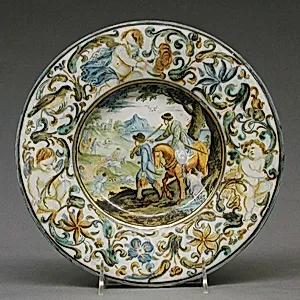
This elegant maiolica plate hails from Castelli, a renowned ceramics center in Italy's Abruzzo region, in the first half of the 18 century. Measuring nearly 10 inches across, tin-glazed earthenware exemplifies the town's mastery of vibrant, durable pottery prized across Europe for both utilitarian and decorative use. Donated to the Metropolitan Museum of Art 1953 by Julia A. Berwind, it graces the European Sculpture and Decor Arts collection. Maiolica's signature tin glaze created a smooth, white surface ideal for vivid underglaze painting, fired at low temperatures to preserve brilliant blues, yellows, and greens without fading. Castelli workshops, active since the 16th century, blended Renaissance traditions with 18th-century Rococo flair, producing plates like this for affluent dining tables. The medium's significance lies in its accessibility—turning everyday objects into canvases for storytelling. Adorned with lively motifs of human figures, playful infants, blooming flowers, and spirited horses, the plate likely evokes pastoral scenes or whimsical narratives, reflecting Italy's Baroque love for movement and nature. Such designs not only delighted owners but also showcased the artisan's skill in capturing motion on fragile clay, bridging art and daily life in 18th-century Europe.