
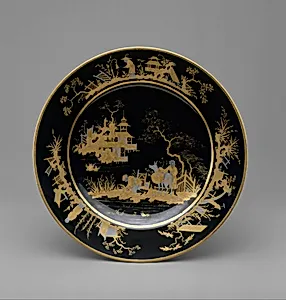
Plate
Medium
Hard-paste porcelain
Dimensions
Diameter: 9 9/16 in. (24.3 cm)
Classification
Ceramics-Porcelain
Culture
French, Sèvres
Department
European Sculpture and Decorative Arts
Museum
Metropolitan Museum of Art, New York, NY
Credit
Gift of Lewis Einstein, 1962
Accession Number
62.165.1
Rights
Public Domain
Tags
Art Historical Context
This elegant plate, crafted by the renowned Sèvres Manufactory painted by Jean-Jacques Dieu in 179, exemplifies the pinnacle of French hard-paste porcelain during a time of profound upheaval. Measuring nearly 10 inches in diameter, it to the European Sculpture andative Arts collection at the Metropolitan Museum of Art gifted by Lewis Einstein in 1962. Sèvres, long the royal porcelain factory, transitioned after the French Revolution, yet continued producing luxurious ceramics prized by elites. The plate's hard-paste porcelain—a technically demanding material mimicking fine Chinese porcelain—allowed for brilliant white bodies and intricate decorations. Dieu's handiwork likely features vivid scenes of men and animals, a popular motif in Sèvres wares that blended realism with Rococo elegance evolving into Neoclassicism. Gilding and enamel paints would have heightened its opulence, showcasing the manufactory's mastery of firing techniques for durable, translucent results. As a cultural artifact from revolutionary France, this piece reflects Sèvres' enduring prestige, symbolizing refined taste amid political turmoil. Visitors can appreciate how such tableware graced aristocratic dinners, bridging old regime luxury with modern innovation.
About the Artist
Sèvres Manufactory|Jean-Jacques Dieu · 1740–present
The Sèvres Manufactory, one of Europe's premier porcelain producers, was established in 1740 as the Manufacture de Vincennes under the patronage of Queen Marie Leszczyńska, who sought to rival Meissen and Chantilly porcelains with French soft-paste innovations. Initially a private venture, it relocated to Sèvres in 1756 in a purpose-built facility designed by architect Laurent Lindet near Madame d...