
Medium
Hard-paste porcelain
Dimensions
Diameter: 9 1/2 in. (24.1 cm)
Classification
Ceramics-Porcelain
Culture
French, Sèvres
Department
European Sculpture and Decorative Arts
Museum
Metropolitan Museum of Art, New York, NY
Credit
Gift of Lewis Einstein, 1962
Accession Number
62.165.17
Rights
Public Domain
Tags
Art Historical Context
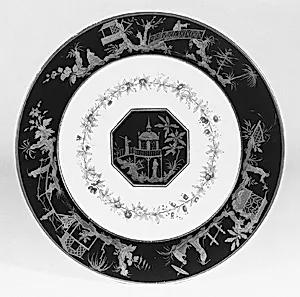
This elegant plate, produced by the renowned Sèvres Manuf in 1791 and painted by Jean-Baptiste-Étienne-Nas Noualhier, the pinnacle of French hard-paste porcelain craftsmanship. 9½ inches in diameter, it created during a turbulent era—the French Revolution—when the state-supported Sèvres factory, long favored by royalty, adapted to produce luxurious tableware for elite clientele. Hard-paste porcelain a technically demanding medium fired at high temperatures for exceptional durability and translucency, allowed Sèvres to rival Chinese imports while showcasing European innovation. The plate's decoration draws from the Chinoiserie style, a fanciful 18th-century European fascination with imagined Chinese aesthetics. Delicate scenes of pavilions—ornate garden structures evoking exotic landscapes—feature intricate overglaze enamels in vibrant blues, golds, and greens, applied with meticulous precision. This technique not only captured the Rococo-era love for whimsy and asymmetry but also highlighted Sèvres' mastery of gilding and polychrome painting. As a gift to the Metropolitan Museum of Art in 1962, this piece offers a window into France's cultural diplomacy through decorative arts, blending Western technical prowess with Eastern-inspired fantasy. Visitors will appreciate its refined beauty, a testament to porcelain's role in everyday luxury.
About the Artist
Sèvres Manufactory|Jean-Baptiste-Etienne-Nicolas Noualhier · 1740–present
The Sèvres Manufactory, one of Europe's premier porcelain producers, was established in 1740 as the Manufacture de Vincennes under the patronage of Queen Marie Leszczyńska, who sought to rival Meissen and Chantilly porcelains with French soft-paste innovations. Initially a private venture, it relocated to Sèvres in 1756 in a purpose-built facility designed by architect Laurent Lindet near Madame d...