
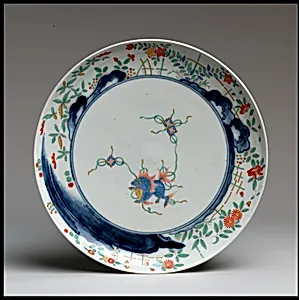
Plate
ca. 1750, decorated 19th century
Medium
Hard-paste porcelain
Dimensions
Diameter: 8 1/4 in. (21 cm)
Classification
Ceramics-Porcelain
Culture
Austrian, Vienna
Department
European Sculpture and Decorative Arts
Museum
Metropolitan Museum of Art, New York, NY
Credit
The Hans Syz Collection, Gift of Stephan B. Syz and John D. Syz, 1995
Accession Number
1995.268.188
Rights
Public Domain
Tags
Art Historical Context
This elegant plate from the Imperial Porcelain Manuf in Vienna exemplifies the refined artistry of 18th-century European porcelain. Produced around 1750 using hard-paste porcelain—a breakthrough medium developed in Europe to rival Chinese imports—this dish features a blank form crafted during the Rococo era, when Vienna's imperial workshops flourished under Habsburg patronage. Its 8¼-inch diameter made it ideal for serving delicate confections or displaying as a collector's piece, now housed in The Metropolitan Museum of Art's European Sculpture and Decorative Arts Department, thanks to The Hans Syz Collection (1995). The significance of hard-paste porcelain lies in its durability and translucency, achieved through high-temperature firing of kaolin clay and feldspar, allowing intricate designs like the mythical creatures hinted at in its decoration—likely added in the 19th century to revive antique glamour. This later overpainting reflects a Victorian fascination with reviving Rococo whimsy, blending eras in a single object. Vienna's manufactory, established in 1718, was renowned for gilded edges and figural motifs inspired by mythology, symbolizing imperial prestige and the era's love for fantasy. As you admire this plate, imagine it gracing a Baroque table, where porcelain bridged East and West, fueling Europe's decorative arts revolution. A testament to technical mastery and timeless allure!
About the Artist
Imperial Porcelain Manufactory ( ) · 1744 –1864
Vienna, 1744–1864