
Plate
Unknown Artist
second half 18th–19th century
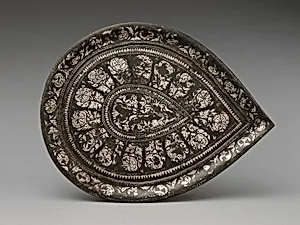
Medium
Zinc alloy; cast, engraved, inlaid with silver (bidri ware)
Dimensions
Max. H. 1 9/16 in. (4 cm) Max. L. 11 3/16 in. (28.4 cm) Max. W. 8 5/8 in. (21.9 cm)
Classification
Metal
Department
Islamic Art
Museum
Metropolitan Museum of Art, New York, NY
Credit
Edward C. Moore Collection, Bequest of Edward C. Moore, 1891
Accession Number
91.1.539
Rights
Public Domain
Art Historical Context
This elegant plate exemplifies *bidri ware*, a metalworking technique from the De region of India, flourishing under Islamic patronage. Crafted from zinc alloy in the second half of the 18th to 19th century, it cast into shape, meticulously engraved, and inlaid with silver to create striking contrasts against a darkened surface treated with a chemical patina. Measuring just 1 9/16 inches high and up to 11 3/16 inches long, its compact, oval form suggests use as a small serving dish or decorative tray in elite households. Bidri ware's origins trace to the 16th century in Bidar, blending Persian influences with local Indian ingenuity, and it became a hallmark of Islamic art in South Asia. The silver inlays often depicted floral motifs, calligraphy, or geometric patterns symbolizing paradise gardens—a nod to Islamic aesthetics—showcasing extraordinary precision and durability. This piece highlights the anonymous artisans' skill in a craft that resisted corrosion, making it prized for both utility and beauty. Now in the Metropolitan Museum of Art's Islamic Art Department, part of the Edward C. Moore Collection (bequeathed 1891), it invites visitors to appreciate the fusion of technology and artistry in everyday luxury objects from a vibrant era of cultural exchange.