
Plate
Unknown Artist
10th century
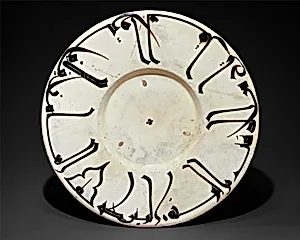
Medium
Earthenware; white slip with black slip decoration under transparent glaze
Dimensions
H. 1 1/2 in (3/8 cm) Diam. 12 in. (30.5 cm) Wt. 25.1 oz (711.7 g)
Classification
Ceramics
Department
Islamic Art
Museum
Metropolitan Museum of Art, New York, NY
Credit
Purchase, Joseph Pulitzer Bequest, 1967
Accession Number
67.178.2
Rights
Public Domain
Art Historical Context
This elegant 10th-century earthenware plate, hailing from the Islamic world, exemplifies the sophisticated ceramic traditions of the medieval Islamic era. Measuring an impressive 12 inches (30.5 cm) in diameter yet remarkably shallow at just 1.5 inches (3. cm) high, it crafted using white slip as base, adorned with intricate black slip decoration, sealed under a transparent glaze This slipware technique—painting designs onto wet clay before firing—created bold contrasts and durable, glossy surfaces, making such pieces both functional for serving food and prized as decorative art. Produced during a golden age of Islamic craftsmanship, likely in regions like Central Asia or Iran under Abbasid or Samanid influence, the plate reflects the era's mastery of pottery. Islamic artisans innovated with slips and glazes when other materials like glass were costly, producing vibrant wares that spread via trade routes from Samarkand to Spain. The black-on-white palette evokes early calligraphy and geometric motifs, honoring cultural taboos on figurative imagery while celebrating abstract beauty. Acquired by The Metropolitan Museum of Art in 1967 through the Joseph Pulitzer Bequest, this plate offers a tangible link to daily life and artistry a millennium ago. Visitors can marvel at its hefty 25.1 oz (711.7 g) weight, hinting at robust construction for communal feasts, and its timeless appeal in the Islamic Art collection.