
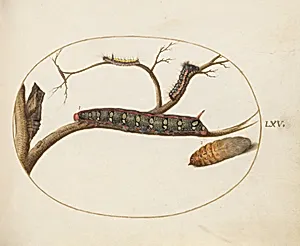
Plate 60: Leafy Spurge Hawkmoth Caterpillar, Gray Dagger Caterpillar, and Pupae
c.1575/1590s
Medium
watercolor and gold paint on parchment
Dimensions
page size (approximate): 14.3 x 18.4 cm (5 5/8 x 7 1/4 in.)
Classification
Drawing
Department
CG-E
Museum
National Gallery of Art, Washington, D.C.
Credit
Gift of Mrs. Lessing J. Rosenwald
Accession Number
1987.20.6.66
Rights
Public Domain
Art Historical Context
Behold the delicate wonders of nature in Joris Hoefel's *Plate 60: Leafy Spurge Hawkmoth, Gray Dagger Caterpillar, Pupae* (c. 1575/1590s). This intimate drawing, measuring just 14.3 x 18.4 cm, showcases the artist's extraordinary skill in rendering the textured forms and subtle hues of these insect larvae and pupae. Hoefnagel, a Flemish master Northern Mannerism, was celebrated for his hyper-detailed natural history studies, bridging art and early scientific observation during the Renaissance. Rendered in watercolor and gold paint on parchment—a medium evoking medieval illuminated manuscripts—the work gleams with metallic accents that mimic the iridescence of life itself. Parchment's fine, translucent surface allowed Hoefnagel to layer colors with precision, capturing every bristle and contour as if under a magnifying glass. Produced amid Europe's burgeoning interest in entomology, it reflects the era's shift toward empirical study of the natural world. Today, this treasure resides in the National Gallery of Art's CG-E Department, a gift from Mrs. Lessing J. Rosenwald. It invites visitors to marvel at how 16th-century artistry laid the groundwork for modern biology illustrations, turning the ephemeral into enduring beauty.
About the Artist
Joris Hoefnagel · 1542–1600
Joris Hoefnagel, also known as Georg Hoefnagel, was born in 1542 in Antwerp to Jacob Hoefnagel, a prosperous diamond and luxury goods dealer, and Elisabeth Vezelaer, daughter of the Antwerp mint master. Intended for the family trade, he received a humanistic education, mastering languages, poetry, and music, but pursued art as a self-taught draftsman and miniaturist, receiving his first lessons fr...