
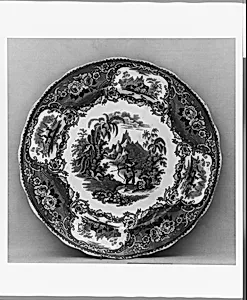
Plate
ca. 1830–ca. 1840
Medium
Earthenware, transfer-printed
Dimensions
Diam. 7 7/8 in. (20 cm)
Classification
Plate
Culture
British (American market)
Department
The American Wing
Museum
Metropolitan Museum of Art, New York, NY
Credit
Bequest of Mary Mandeville Johnston, from the collection of Mr. and Mrs. Edward W. S. Johnston, 1914
Accession Number
14.102.192
Rights
Public Domain
Tags
Art Historical Context
This elegant earthenware plate, produced by the renowned British pottery firm William Adams & Sons around1830–1840, exemplifies the vibrant export trade in ceramics to the American market. Measuring 7⅞ inches in diameter, it features transfer-printed decoration—a revolutionary technique that allowed intricate designs to be mass-produced affordably. Ink was printed onto tissue paper, transferred to the unglazed clay, and then fired under glaze, yielding sharp, durable images that captured scenes of animals, hunting, and trees, evoking the romantic English countryside. Widely popular in American households during the early 19th century, such plates blended British craftsmanship with transatlantic tastes, serving both practical dining needs and decorative flair. William Adams & Sons, based in Staffordshire, specialized in these colorful, narrative motifs, making fine tableware accessible to the growing middle class. The transfer-printing process democratized artistry, transforming everyday objects into storytelling canvases of leisure and nature. Now housed in The Metropolitan Museum of Art's American Wing, this piece entered the collection in 1914 through the bequest of Mary Mandeville Johnston. It offers a window into the cultural exchange between Britain and America, highlighting how imported goods shaped domestic life in the young republic.