
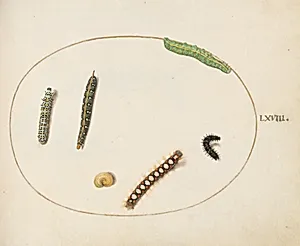
Plate 68: Leafy Spurge Hawkmoth Caterpillar, Mullein Moth Caterpillar, and Other Caterpillars
c.1575/1590s
Medium
watercolor and gold paint on parchment
Dimensions
page size (approximate): 14.3 x 18.4 cm (5 5/8 x 7 1/4 in.)
Classification
Drawing
Department
CG-E
Museum
National Gallery of Art, Washington, D.C.
Credit
Gift of Mrs. Lessing J. Rosenwald
Accession Number
1987.20.6.69
Rights
Public Domain
Art Historical Context
Step into the meticulous world of 16th-century natural history with *Plate 68: Leafy Spurge Hawkmoth, Mullein Moth, and Other Caterpillars by Joris Hoefnagel, created around 1575–1590s. This delicate drawing captures the intricate forms of various caterpillars against a subtle backdrop, showcasing Hoefnagel's mastery as a Flemish miniaturist renowned for his hyper-realistic depictions of insects and flora. As one of the earliest artists to elevate nature studies to fine art, Hoefnagel blended scientific precision with artistic wonder, reflecting the Renaissance fascination with the natural world. Rendered in watercolor and gold paint on parchment—a luxurious medium evoking illuminated manuscripts—the work measures just 14.3 x 18.4 cm, perfect for intimate study or princely collections. The shimmering gold accents highlight textures like spiky bristles and segmented bodies, demonstrating advanced techniques in transparency and luminosity that bring these tiny creatures vividly to life. Parchment's smooth surface allowed for exquisite detail, underscoring the piece's role in the era's shift toward empirical observation. Housed in the National Gallery of Art's CG-E department as a gifted treasure from Mrs. Lessing J. Rosenwald, this plate invites visitors to marvel at nature's hidden intricacies. It embodies the cultural bridge between art, science, and patronage, reminding us how 16th-century eyes first framed the microscopic beauty we now explore through modern lenses.
About the Artist
Joris Hoefnagel · 1542–1600
Joris Hoefnagel, also known as Georg Hoefnagel, was born in 1542 in Antwerp to Jacob Hoefnagel, a prosperous diamond and luxury goods dealer, and Elisabeth Vezelaer, daughter of the Antwerp mint master. Intended for the family trade, he received a humanistic education, mastering languages, poetry, and music, but pursued art as a self-taught draftsman and miniaturist, receiving his first lessons fr...