
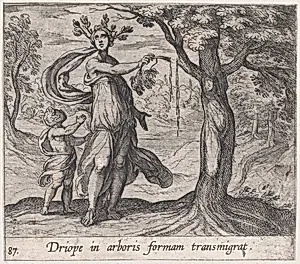
Plate 87: Dryope Changed into a Lotus Tree (Driope in arboris formam transmigrat), from Ovid's 'Metamorphoses'
1606
Medium
Etching
Dimensions
sheet: 15 9/16 x 20 1/2 in. (39.5 x 52 cm) plate: 4 1/8 x 4 3/4 in. (10.5 x 12 cm)
Classification
Prints
Department
Drawings and Prints
Museum
Metropolitan Museum of Art, New York, NY
Credit
The Elisha Whittelsey Collection, The Elisha Whittelsey Fund, 1951
Accession Number
51.501.3953
Rights
Public Domain
Tags
Art Historical Context
Behold Plate 87 from Antonio Tempesta's masterful 1606 series of etchings illustrating Ovid's *Metamorph*, a cornerstone of classical mythology that captivated Renaissance artists. Titled *Dryope Changed into a Lotus* (or *Driope in arbor formam transmigrat this work captures the poignant moment from Book 9, where the innocent Dryope—plucking flowers from a nymph as a lotus—undergoes a divine metamorphosis. Her body twists into bark and branches, her child clinging desperately to her transforming form, evoking themes of fate, innocence, and the blurred line between human and nature. Tempesta, a prolific Italian etcher active in late Mannerist and early Baroque circles, excelled in printmaking's intricate possibilities. Etching allowed him to render fine, expressive lines on a modest plate (4 1/8 x 4 3/4 in.), enabling mass reproduction of these vivid myths for collectors across Europe. The sheet's larger format (15 9/16 x 20 1/2 in.) highlights the detailed tableau of women, children, and entwining trees, blending drama with botanical precision. Housed in the Metropolitan Museum of Art's Drawings and Prints department, this piece from The Elisha Whittelsey Collection underscores the cultural revival of Ovid during the 17th century, making ancient tales accessible and sparking endless artistic inspiration. A timeless reminder of transformation's terror and beauty.
About the Artist
Antonio Tempesta · 1555–1630
Antonio Tempesta (1555–1630), known as 'Il Tempestino,' was a Florentine painter and printmaker whose extraordinary output of approximately 1,700 etchings made him one of the most influential printmakers of the early Baroque period. Born in Florence and trained under Santi di Tito and the Flemish master Joannes Stradanus, he enrolled in the Accademia del Disegno in 1576 before relocating to Rome i...