
Plate
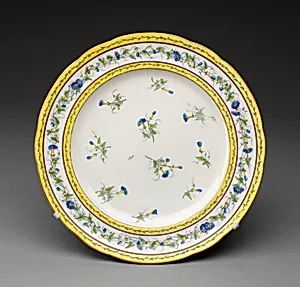
Medium
Soft-paste porcelain, polychrome enamels, and gilding
Dimensions
2.7 × 24.2 cm (1 1/16 × 9 1/2 in.)
Classification
plate (general, dish)
Department
Applied Arts of Europe
Museum
Art Institute of Chicago
Accession Number
135749
Rights
Public Domain
Art Historical Context
This elegant plate from the Manufacture nationale de Sèvres, created in 1788, exemplifies the pinnacle of French porcelain artistry on the eve of the Revolution. Produced at the royal factory near Versailles, Sèvres was renowned for supplying the court of Louis XVI with luxurious tableware that blended technical innovation with opulent decoration. Measuring just 2.7 × 24.2 cm, its shallow, oval form suggests it was designed for serving delicate confections or as part of an elaborate dinner service, reflecting the refined dining customs of 18th-century aristocracy. Crafted from soft-paste porcelain—a French specialty before the widespread adoption of harder Chinese-style paste—this piece showcases masterful techniques like polychrome enamels and gilding. The enamels, fired at low temperatures, allowed for vibrant, multi-hued designs, while gilding added a shimmering gold accents, often in intricate borders or motifs inspired by neoclassical tastes. These methods not only enhanced durability but also created a jewel-like sheen, making Sèvres porcelain a symbol of prestige. Housed in the Art Institute of Chicago's Department of Applied Arts of Europe, this plate highlights the cultural zenith of French decorative arts, where functionality met extravagance. It invites visitors to imagine the candlelit salons where such objects graced royal tables, underscoring porcelain's role as a canvas for national pride and artistic excellence.
About the Artist
Manufacture nationale de Sèvres · 1763–1800
The Manufacture nationale de Sèvres, a premier French porcelain factory, flourished from 1763 to 1800 as the royal powerhouse of European ceramics, producing opulent soft- and hard-paste porcelain under the patronage of Louis XV and XVI. Originally founded in Vincennes in 1740 to rival Meissen and Chantilly, it relocated to Sèvres in 1756 and was fully acquired by the Crown in 1759, becoming the M...