
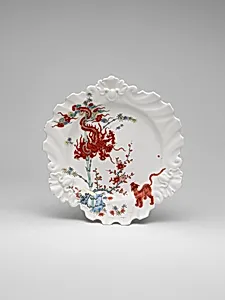
Plate decorated with Japanese Kakiemon-inspired scene with twisted dragon
ca. 1752, probably Raised Anchor Period
Medium
Soft-paste porcelain
Dimensions
confirmed, irregular diameter: 1 1/2 × 9 in. (3.8 × 22.9 cm)
Classification
Ceramics-Porcelain
Culture
British, Chelsea
Department
European Sculpture and Decorative Arts
Museum
Metropolitan Museum of Art, New York, NY
Credit
Purchase, Larry and Ann Burns Gift, in honor of Austin B. Chinn, 2018
Accession Number
2018.378
Rights
Public Domain
Tags
Art Historical Context
This elegant plate, crafted around 1752 by the Chelsea Porcelain Manufactory in Britain, exemplifies the era’s fascination with East Asian aesthetics. Produced during the Raised Anchor Period, it features a lively scene inspired by Japanese Kakiemon porcelain, complete with a twisting dragon and tigers rendered in delicate overglaze enamels. The soft-paste porcelain body, with its slightly irregular nine-inch diameter, highlights the technical challenges European makers faced while striving to replicate the translucent quality of Asian wares. Chelsea’s artisans drew directly from imported Japanese designs, blending them with British tastes during a time when chinoiserie motifs flourished across Europe. The factory, one of England’s earliest successful porcelain producers, used soft-paste formulas that allowed for vibrant colors and intricate details, making pieces like this both functional and collectible. Acquired by the Metropolitan Museum of Art in 2018, the plate reflects the lively cultural exchange between Britain and Asia in the mid-eighteenth century.
About the Artist
Chelsea Porcelain Manufactory · 1744–1784
**Chelsea Porcelain Manufactory** The Chelsea Porcelain Manufactory, Britain's pioneering porcelain enterprise, was founded around 1743 in Chelsea, London, by two Huguenot silversmiths: Nicholas Sprimont from Liège and Charles Gouyn. Sprimont, trained in Paris as a goldsmith before immigrating to England, brought his expertise in luxury metalwork to the venture, while Gouyn handled early sales th...