
Plate Five from Evenings in Rome
1763/64
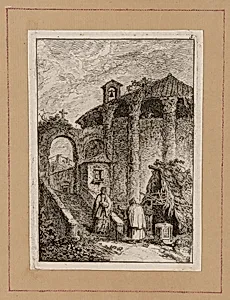
Medium
Etching in black on off-white laid paper, tipped onto tan laid paper
Dimensions
Plate: 13.8 × 9.4 cm (5 7/16 × 3 3/4 in.); Secondary Support: 18.5 × 13.7 cm (7 5/16 × 5 7/16 in.)
Classification
etching
Department
Prints and Drawings
Museum
Art Institute of Chicago
Accession Number
206976
Rights
Public Domain
Art Historical Context
Hubert Robert, a masterful French artist often called the "Robert des Ruines," created *Plate Five from Evenings in Rome* during his formative years in Italy (1755–1764). This etching, dated 1763/64, captures the enchanting twilight ambiance of Rome, reflecting Robert's deep fascination with the city's ancient ruins and classical heritage. As a winner of the prestigious Prix de Rome, he immersed himself in the Eternal City's landscapes, blending real architecture with imaginative elements in his signature style of picturesque "capricci"—fantastical architectural views that evoke nostalgia for antiquity. Rendered as an etching in black ink on off-white laid paper and later tipped onto tan laid paper, the work measures a intimate plate size of 13.8 × 9.4 cm. Etching allowed Robert to achieve exquisite precision and tonal depth: he drew lines into a wax-coated copper plate, which acid then etched to create delicate, atmospheric effects ideal for conveying evening light and shadow over Roman vistas. This printmaking technique democratized his vision, making grand scenes accessible beyond oil paintings. Housed in the Art Institute of Chicago's Prints and Drawings Department, this piece exemplifies Robert's influence on Neoclassicism and Romanticism, inspiring generations to romanticize decay and timeless beauty. Visitors will appreciate its subtle poetry—a window into 18th-century Grand Tour reveries.
About the Artist
Hubert Robert · 1733–1808
Hubert Robert, born on May 22, 1733, in Paris, emerged from a modest background; his father, Nicolas Robert, served the influential Choiseul family, whose patronage shaped the young artist's path. After completing his studies at the Jesuit Collège de Navarre in 1751, he entered the atelier of sculptor Michel-Ange Slodtz, who taught him design and perspective before encouraging a shift to painting....