
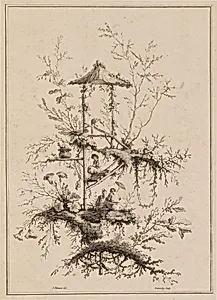
Plate from a Set of Chinoiserie Representations
Medium
Classification
Department
Smithsonian Collection
Museum
Smithsonian American Art Museum
Credit
Gift of Eleanor and Sarah Hewitt
Accession Number
1920-36-179
Rights
Public Domain
About this artwork
Research in Progress
Art Historical Context
This exquisite plate, part of a set of *Chinoiserie Representations by French artist Jean-Baptiste Pillement (172–1808), dates to 1780–1790 and showcases the print medium's role in disseminating decorative designs. Pillement, a master of the Rococo style, was renowned for his intricate landscapes, tapestries, and whimsical of Eastern motifs, blending European elegance with imagined Chinese aesthetics. Chinoiserie flourished in 18th-century Europe as a playful fantasy of the exotic "Orient," adorning furniture, wallpapers, and porcelain for aristocratic homes. Pillement's prints, likely etched or engraved, served as patterns for luxury goods, capturing pagodas, flowing robes, and lush foliage in delicate lines. Produced on the eve of the French Revolution, they reflect a final flourish of opulent pre-Revolutionary taste. Generously gifted to the Smithsonian American Art Museum by Eleanor and Sarah Hewitt, this work highlights the enduring appeal of cross-cultural artistry. Though research continues, it invites visitors to appreciate how prints bridged fine art and everyday decoration, sparking imagination across continents.