
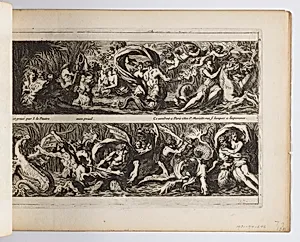
Plate from "Frises, feuillages ou tritons marins, à la romaine"
ca. 1640–1682
Classification
Department
Smithsonian Collection
Museum
Smithsonian American Art Museum
Credit
Gift of Eleanor and Sarah Hewitt
Accession Number
1931-94-646
Rights
Public Domain
About this artwork
Research in Progress
Art Historical Context
Jean Le Pautre (1618–1682), a leading French engraver of the Baroque era, created this plate from his series *Frises,illages ou tritonsins, à la romaine (Friezes, Foliage, or Marine Tritons in the Roman Style) sometime between circa 1640 and 1682. Working during the opulent reign of Louis XIV, Le Pautre specialized in intricate ornamental prints that drew inspiration from classical antiquity, blending Roman motifs with the lavish decorative tastes of 17th-century France. These designs were highly influential for architects, furniture makers, and interior decorators seeking to evoke grandeur in palaces, churches, and homes. The plate showcases elaborate friezes featuring scrolling foliage and mythical marine tritons—half-man, half-fish creatures from ancient mythology—rendered in a "Roman" style that revived the dynamic energy of imperial motifs. As a print, it exemplifies Le Pautre's mastery of line work and pattern-making, tools essential for disseminating decorative ideas across Europe before photography. Such works fueled the era's passion for *grotesques*, whimsical hybrid forms popularized by Renaissance rediscoveries of Roman frescoes like those in Nero's Domus Aurea. Today, this piece graces the Smithsonian American Art Museum, a gift from Eleanor and Sarah Hewitt, highlighting Le Pautre's enduring legacy in design history. Ongoing research promises to reveal more about its production techniques and precise context, inviting us to appreciate its timeless elegance.