
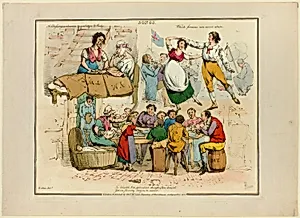
Plate from Illustrations to Popular Songs
1822
Medium
Soft ground etching with hand-coloring and aquatint on paper
Dimensions
Image: 20.2 × 25.5 cm (8 × 10 1/16 in.); Plate: 21 × 27 cm (8 5/16 × 10 11/16 in.); Sheet: 24.5 × 34 cm (9 11/16 × 13 7/16 in.)
Classification
etching
Department
Prints and Drawings
Museum
Art Institute of Chicago
Accession Number
128485
Rights
Public Domain
Art Historical Context
Henry Alken (1785–1851), a prolific British artist renowned for his lively depictions of scenes, hunting, and everyday Regency life, created this *Plate from Illustrations to Popular* in 1822. During the vibrant post-Napoleonic era, when popular songs and broadsheets flourished among the working and middle classes, Alken illustrations brought lyrics to vivid life. His whimsical, caricatured style captured the humor and energy of British social customs, making art accessible through affordable prints. This work exemplifies early 19th-century printmaking innovation: soft-ground etching allowed for fluid, expressive lines mimicking pencil sketches, while aquatint added rich tonal gradients for depth and atmosphere. Hand-coloring by skilled artisans enhanced its appeal, transforming the monochromatic plate into a colorful, collectible gem—ideal for home display alongside sheet music. Measuring a modest 20.2 × 25.5 cm, this etching from the Art Institute of Chicago's Prints and Drawings collection offers visitors a delightful window into Georgian entertainment culture. Alken's masterful blend of technique and satire highlights printmaking's role in democratizing art, bridging high culture with popular pastimes.
About the Artist
Henry Alken · 1785–1851
Henry Thomas Alken (1785–1851) was a British sporting artist and illustrator who became the most popular and prolific painter of hunting, racing, and coaching scenes in early nineteenth-century England. Born in London, he was the son of the sporting artist Samuel Henry Alken and received his earliest training from his father. He also studied briefly with the miniaturist John Thomas Barber Beaumont...