
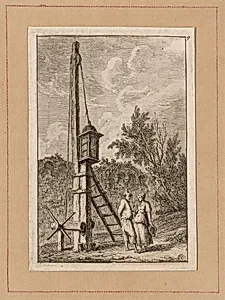
Plate Nine from Evenings in Rome
1763/64
Medium
Etching in black on off-white laid paper, tipped onto tan laid paper
Dimensions
Plate: 13.5 × 9.3 cm (5 3/8 × 3 11/16 in.); Secondary Support: 18.7 × 13.6 cm (7 3/8 × 5 3/8 in.)
Classification
etching
Department
Prints and Drawings
Museum
Art Institute of Chicago
Accession Number
206980
Rights
Public Domain
Art Historical Context
Hubert Robert, a masterful French artist often dubbed "Robert des Ruines," created *Plate Nine from Evenings in Rome* during his formative years in Italy (1755–1765). Dated 1763/64, this etching captures the enchantment of Rome's twilight vistas, part of a series evoking the city's ancient grandeur amid fading light. Robert's sojourn in the Eternal City profoundly shaped his neoclassical style, blending precise architectural observation with romantic imagination, influencing generations of landscape and veduta painters. Executed as a black etching on off-white laid paper and tipped onto tan laid paper (plate: 13.5 × 9.3 cm), the work exemplifies 18th-century printmaking techniques. Etching allowed Robert to incise intricate lines into a copper plate with acid, producing finely detailed, reproducible images that brought Roman splendor to collectors across Europe. This intimate scale made it accessible, democratizing the Grand Tour experience for those who couldn't travel. Housed in the Art Institute of Chicago's Prints and Drawings Department, this gem highlights Robert's skill in evoking mood through shadow and stone. Visitors can marvel at how such a small print encapsulates the poetic decay of antiquity, inviting reflection on time's gentle erosion.
About the Artist
Hubert Robert · 1733–1808
Hubert Robert, born on May 22, 1733, in Paris, emerged from a modest background; his father, Nicolas Robert, served the influential Choiseul family, whose patronage shaped the young artist's path. After completing his studies at the Jesuit Collège de Navarre in 1751, he entered the atelier of sculptor Michel-Ange Slodtz, who taught him design and perspective before encouraging a shift to painting....